
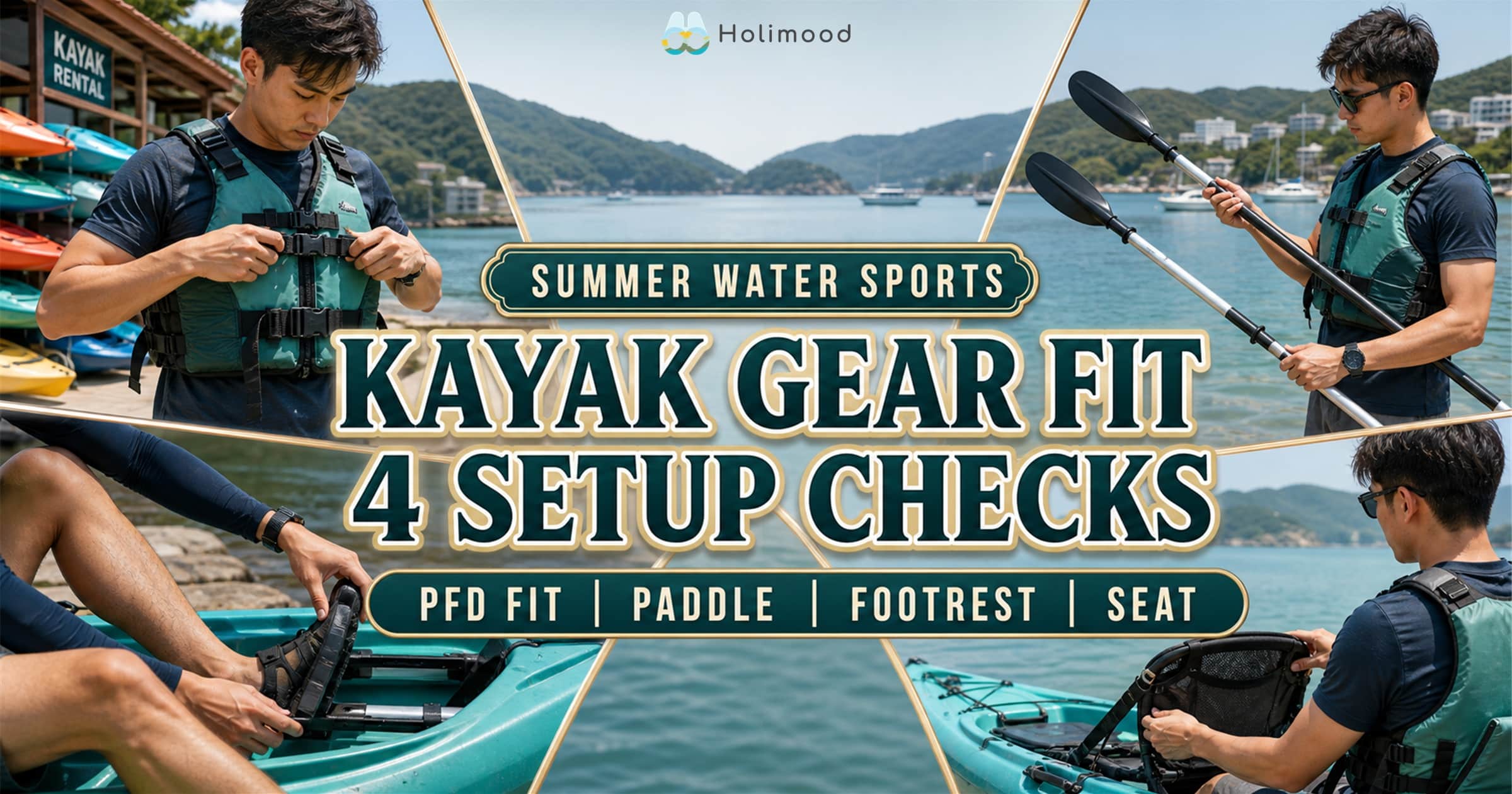
Why should rental kayak gear be fitted individually?
A clothing size does not guarantee that a PFD fits correctly, and height alone does not determine paddle length or footrest position. Body shape, arm length, kayak width, seating design and what you wear all affect the setup. Loose flotation gear may ride upward; an over-tight PFD can restrict breathing. Footrests that are too far away remove a useful point of contact, while a cramped setting can strain the knees. These problems are easier to identify on land than after the group has entered the water.
Complete the checks on dry ground with the kayak stabilised and away from the launch lane. Review the Hong Kong Observatory forecast and thunderstorm warning, then follow the operator’s live instructions. Correctly fitted equipment does not replace weather judgement, swimming ability, supervision or a route appropriate to the group.
How do you complete the four gear-fit checks?
1. Fasten the PFD, tighten evenly and perform a lift test
Secure every zip, waist buckle and chest buckle provided by the design. Tighten the straps from the lower section upward until the PFD is snug but normal breathing and torso rotation remain possible. Ask a companion or staff member to lift gently at the shoulders. If the body of the PFD moves above the chin, covers the face or reaches the ears, it is too loose or the wrong size. Never rely on one strap, tie knots in the webbing or alter a buckle. Recheck the fit for children, slender participants and anyone wearing an extra sun-protection layer.
2. Choose a paddle that keeps shoulders and wrists neutral
A longer paddle is not automatically easier. With both hands spaced evenly on the shaft, the elbows should remain slightly bent and the shoulders relaxed. Rehearse a forward stroke and recovery on land. If the blade repeatedly meets the kayak, the wrist twists awkwardly or the paddler must lean far to one side, ask staff to review the length, hand spacing and blade orientation. In a tandem kayak, both participants should test their own setup rather than assuming one choice suits everyone.
3. Set the footrests for light knee bend and stable contact
Sit in a kayak that is secured on land or held stable by staff. Move the footrests until both feet make reliable contact while the knees remain naturally bent. Simulate the upper-body motion of paddling: the back should not have to leave the seat just to reach the rests. Left and right settings should match. If a mechanism sticks, do not force it; ask the operator to inspect it. Kayaks without adjustable rests may require a different seating or support solution specified by staff.
4. Adjust the seat and back band without blocking rotation
The cushion should lie flat and the back band should support the lower back rather than push the torso forward. Practise turning left and right, leaning slightly forward and returning upright. A slipping strap, a buckle pressing into the body or numbness in the legs is a reason to stop and readjust. Do not wedge phones, keys or hard containers behind the back band because they change the support and can become uncomfortable over a longer paddle.
What does a good fit look like?
| Equipment | Good-fit signal | Common problem | Dry-land action |
|---|---|---|---|
| PFD | Normal breathing; lift test stays below chin | Rides upward, rubs underarms, partly fastened | Refasten, resize and ask staff to verify |
| Paddle | Relaxed shoulders, even grip, neutral wrists | Hits kayak, causes shrugging or excessive leaning | Review length, hand spacing and blade direction |
| Footrests | Even contact with a natural knee bend | Uneven, too distant or cramped | Adjust one step at a time; never force a jam |
| Seat | Lower-back support with free rotation | Loose band, pressure point or numb legs | Retighten and remove hard objects |
The standard is not simply whether discomfort is tolerable. The participant should be able to breathe, see clearly and move naturally while maintaining stable contact with the kayak. Pain, numbness, dizziness or persistent anxiety requires a pause and a conversation with the operator; shortening the route is not a substitute for replacing unsuitable equipment.
How can a group add fitting to its launch routine?
- Before booking: confirm headcount, adults and children, major fit differences, kayak type, session time and venue rules.
- On arrival: change, apply sun protection and store belongings before collecting paddles.
- On dry land: check PFD, paddle, footrests and seat in that order, with a partner cross-check.
- At the shoreline: confirm no buckle loosened while carrying equipment and that waterproof bags are secured.
- Launch only when complete: enter the launch lane under staff direction and avoid last-minute adjustment on a slope.
For a group of eight to ten, split participants into two fitting waves. While the first group works through the equipment checks, the second remains in a waiting area to organise sun protection and personal items. Each paddler and their kayak partner should confirm the result; one leader should not assess everyone by sight. Families can also use the family kayak launch queue, while the wet-gear return routine helps after the activity.
Three common misconceptions
Myth 1: tighter is always safer. An over-tight PFD restricts breathing and movement; the goal is a secure fit that does not ride upward.
Myth 2: people of the same height need the same paddle. Arm length, kayak width and paddling mechanics matter too.
Myth 3: footrests are best adjusted at the water’s edge. They should be set with the kayak stabilised on land to avoid blocking the lane or losing balance.
How do Holimood water-sports options fit the plan?
Compare more than price. Check kayak types, whether a PFD and paddle are included, changing and shower facilities, storage, adult-supervision rules, return times and weather arrangements. Holimood lists Hoi Ha Wan kayak and SUP rental and Sha Ha Road kayak and SUP rental, while groups wanting instruction can compare the Sai Kung private SUP class. Equipment models, available sizes, age rules, prices, payment and cancellation or rescheduling arrangements must be confirmed on the current booking page and with the operator.
First-time participants can read the Hong Kong kayak and SUP rental guide and the water-sports sun and hydration timetable. In marine parks, review the AFCD marine-park activity guidance; before entering busy waters, consult the Marine Department pleasure-vessel information.
The PFD stays below the chin during a lift test; paddle length does not raise the shoulders; footrests are even; the seat supports the lower back. Recheck weather and staff instructions before launch, then compare current locations, equipment and booking terms on Holimood.
Frequently Asked Questions
Can a PFD be worn over a thick jacket?
Fit it again over the clothing that will actually be worn. All fasteners must close correctly and normal breathing must remain possible. Ask staff to confirm the size and wearing method.
What happens if a paddle is too long or too short?
It can cause shoulder shrugging, repeated contact with the kayak, awkward wrist angles or excessive leaning. If the dry-land rehearsal already feels unnatural, change it before launch.
Should both tandem paddlers adjust their footrests?
Yes. Each seating position should be set for its occupant, followed by a joint check that both paddlers can move without interfering with one another.
Can worn rental equipment still be used?
Stop and report cracked buckles, slipping webbing, damaged shafts, jammed footrests or an unstable seat. Do not make an improvised repair and enter the water.
Can I swap kayaks or paddles after the fitting?
Any swap requires the relevant checks to be repeated and the group or staff allocation to be updated. Keep checked and unchecked equipment separate.
Make gear fitting part of every launch
A smooth kayaking session starts on dry land. Adjust the PFD, paddle, footrests and seat in a fixed order so unsuitable or damaged equipment is found early. Launch only after the checks and current staff instructions are complete; if weather or physical condition changes, pause and reassess.
Subscribe to the Holimood Newsletter: receive practical updates on Hong Kong water sports and outdoor experiences.
This post is also available in:
 繁體中文
繁體中文  简体中文
简体中文

