
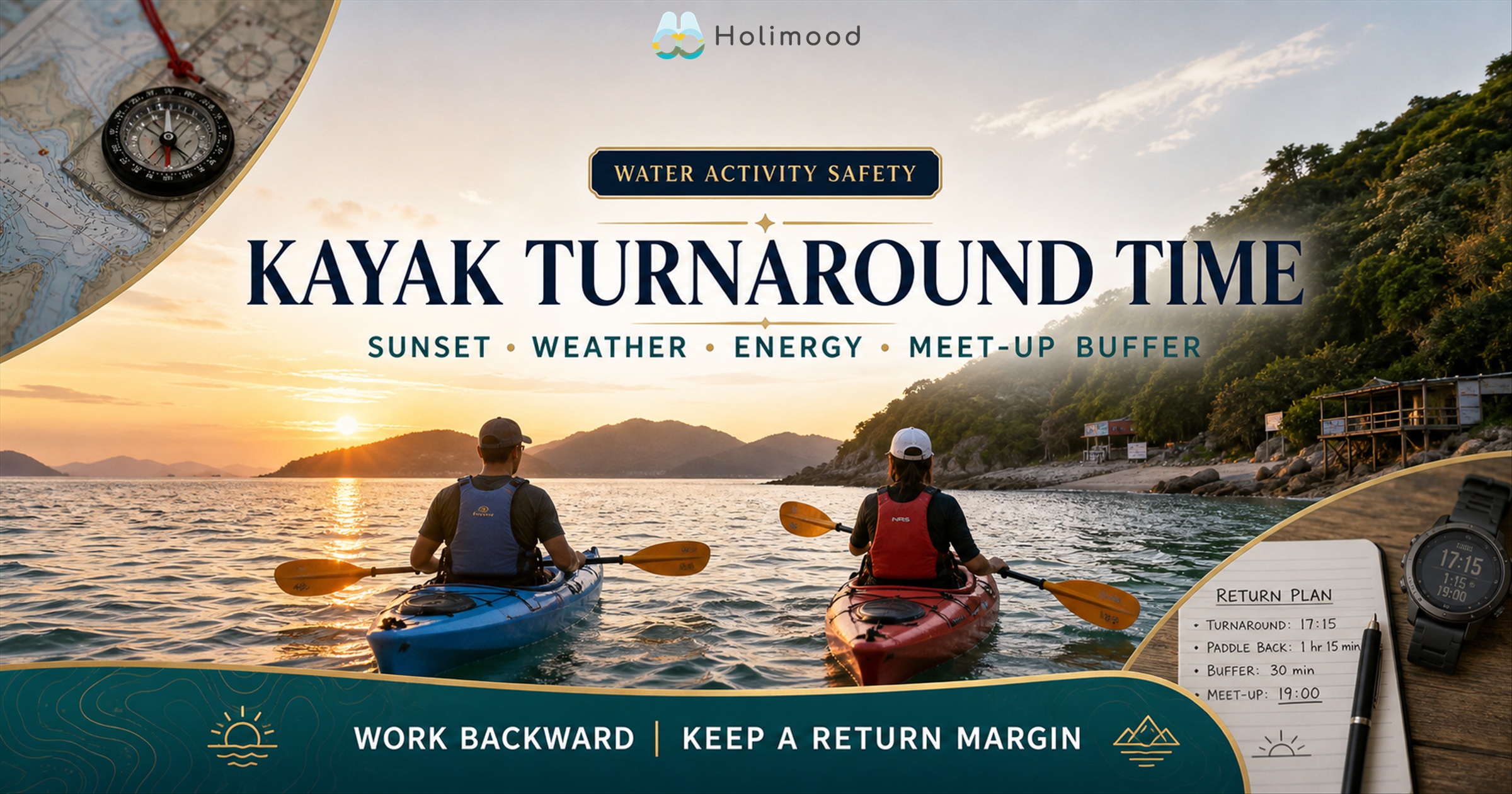
Late returns often happen because sunset, wind, fatigue, photo stops and gear return are planned separately. A stronger method defines when everybody and all equipment must be fully back, then works backward. It applies to out-and-back routes around Hoi Ha Wan, Sha Ha and other Hong Kong launch points.
Use one formula to calculate the turnaround
Turnaround time = earliest hard deadline − shore and return processing − conservative paddle-back time − safety margin. The deadline may be earlier than sunset: a 17:00 rental return, a guide’s meet-up time or a forecast change can become the controlling limit.
Why should return time be conservative?
Paddlers begin fresh, but may return against wind, current or fatigue, with a group spreading out. Start with 1.3 to 1.5 times the observed outbound time and adjust for the slowest paddler and current conditions. This is planning guidance, not a safety guarantee; shorten the route immediately if sea state or visibility worsens.
Landing is not the end of the booking
Allow 15–30 minutes for regrouping, carrying kayaks, rinsing, counting paddles and PFDs, changing and handing gear back. Families, beginners and larger groups normally need more time.
Four inputs to check before launch
- Sunset and twilight: use the activity date in the Hong Kong Observatory Almanac.
- Wind, thunderstorms and visibility: check the current HKO report before and during the trip.
- The slowest paddler: use their pace, fatigue, hydration and concentration as the group baseline.
- Rental and meeting terms: confirm the last return time, route limits, equipment and shore facilities.
In marine parks, consult the AFCD visitor code. It advises water users to wear a life jacket and act within their capabilities; beaches in marine parks may not have lifeguards.
Worked example: which limit comes first?
| Scenario | Input | Turnaround decision | Extra margin |
|---|---|---|---|
| Same launch, out and back | 50 minutes outbound; gear due by 17:00 | Allow 70 minutes back, 15 minutes ashore and 20 minutes group margin: turn by about 15:15 | Earlier if wind rises or the slowest boat drops back |
| Sunset photography | Golden-hour goal but a dim return shoreline | Set a safe landing time; sunset is not the turnaround time | Visibility and shoreline recognition |
| Mixed-ability group | Singles, doubles and beginners | Let the slowest boat set pace and use fixed checkpoints | Headcounts, water breaks and regrouping |
| Weather deterioration | Rising wind, cloud or distant thunder | Abandon the planned limit and return early | Safety overrides the itinerary |
The 15:15 example is a method, not a universal answer. Recalculate with the actual trip, conditions and operator rules. Use the Hong Kong kayak and SUP guide, the season and weather guide, and the Sai Kung summer route timetable for route context.
Make the turnaround a shared group instruction
Set three times before departure
- A first conditions check 20–30 minutes after launch.
- A written latest turnaround that anyone may bring forward.
- A completed-return time that includes gear and changing.
Recalculate after every stop
Photography, snorkelling, shore breaks and waiting all consume return margin. Compare remaining time against conservative paddle-back plus shore processing. HKO guidance says people should get out of the water when a thunderstorm warning is in force; do not treat lightning as a routine delay.
Three common misconceptions
- Outbound equals return. Fatigue and headwind can slow the group.
- Turn at sunset. Safe landing should precede darkness.
- Rental end time means touching shore. Carrying, rinsing and return checks also take time.
Match the timing plan to a Holimood water activity
Compare operating hours, return rules, route limits, changing facilities and age requirements as well as price. Holimood brings these details together, while live availability and operator terms remain controlling.
- Hoi Ha Wan kayak and SUP rental: review daytime hours, PFDs, paddles and changing facilities.
- Sha Ha kayak and SUP rental: compare parking, showers and gear-return logistics.
- Private Sai Kung SUP session: beginners can check instruction and meeting arrangements before extending a route independently.
Confirm current hours, capacity, gear, weather policies and charges on the booking page. HKO also advises water users to take special care in high winds and rough seas when the Strong Monsoon Signal is in force.
FAQ
How long before sunset should a kayak group turn back?
There is no universal number. Set a safe landing time, subtract conservative paddling, shore processing and a separate margin; use an earlier rental or weather deadline if applicable.
Can I estimate the return from map distance alone?
No. Wind, current, boat type, fatigue and the slowest paddler materially affect duration.
What if one paddler slows down?
Recalculate immediately around that boat. Shorten the route or return early if the margin is no longer adequate.
Can we wait for rain to ease during a thunderstorm warning?
Do not treat a thunderstorm as ordinary rain. Follow official and on-site guidance to leave the water and seek the safest landing or shelter.
What should I confirm with the rental operator?
Ask about final gear return, permitted range, included PFDs and paddles, severe-weather arrangements, showers, storage and overtime rules.
This post is also available in:
 繁體中文
繁體中文  简体中文
简体中文

