
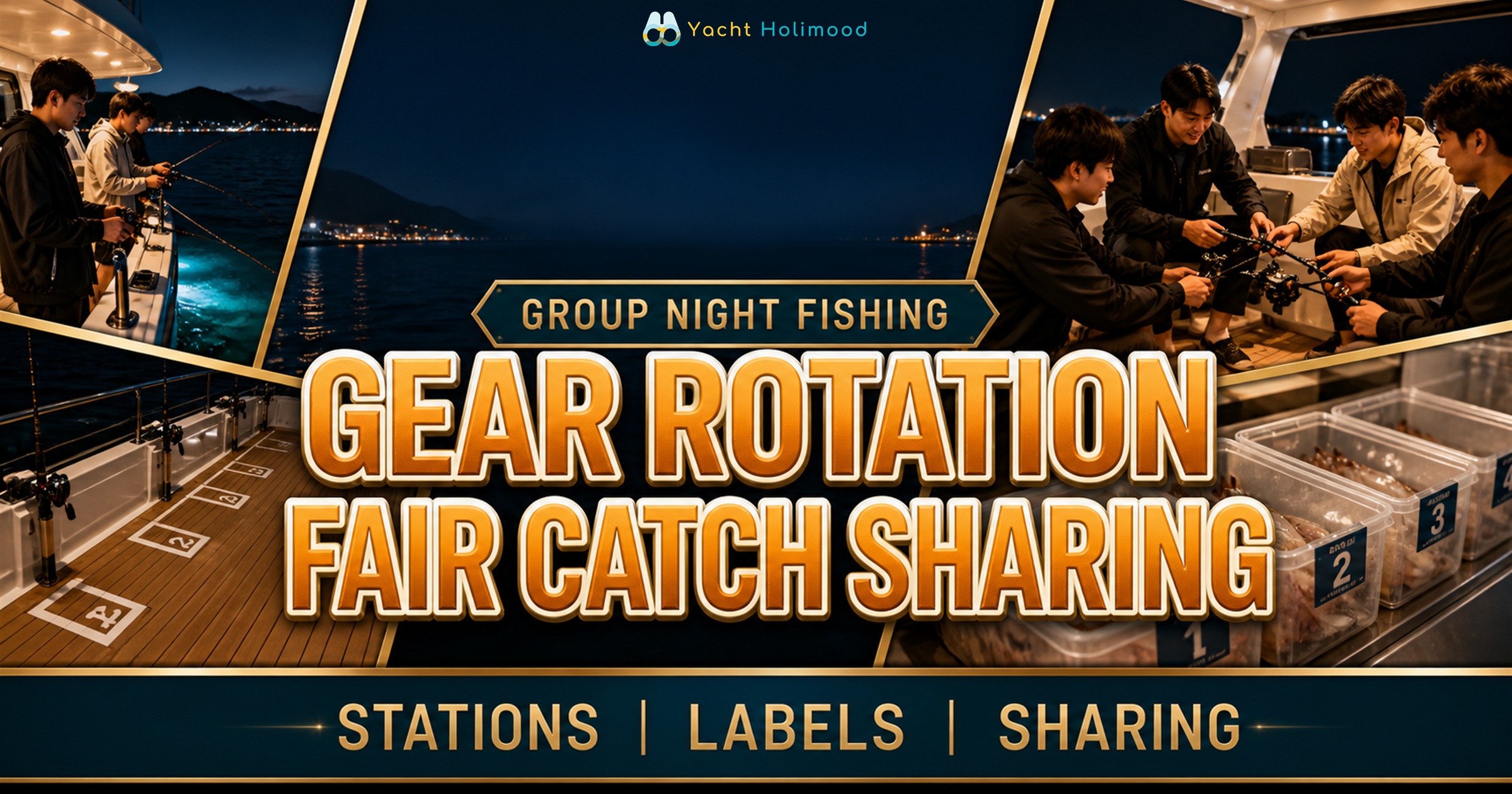
Why organise teams before boarding?
A group of eight to twenty may include first-time anglers, guests who want several rounds, photographers, and companions who mainly want dinner and the night view. If priorities are decided only after boarding, a few people may occupy the best rail positions, a handover may begin before the line is retrieved, and catches may enter one container with no record of the agreed sharing unit. The management problem is limited stations, shared equipment and shared time—not who appears most skilled.
New participants can review the Hong Kong squid-fishing beginner flow and night squid-fishing gear checklist. Put meeting, demonstration, fishing rounds, dinner, pack-down and return on one run sheet. Check the Hong Kong Observatory marine forecast, while recognising that the operator’s safety decision governs departure, fishing stops and stations.
What belongs on a station and rotation plan?
| Field | Record | Avoid |
|---|---|---|
| Team | Two to four guests, mixing first-timers with someone comfortable following the demonstration | Placing all first-timers together without support |
| Station | Only the numbered or safe positions assigned by crew | Passageways, stairs or life-saving equipment areas |
| Round | A 15–20 minute starting point, with full retrieval before handover | Swapping while a line remains in the water |
| Equipment | Check jig, line and personal items together during handover | Wet equipment spread across seats or dining space |
| Catch-up round | One short final round for missed participation or coaching | Open-ended extensions that displace safe pack-down |
One person reads the order before fishing and the crew demonstrates retrieve, release and spacing. The outgoing angler retrieves fully, confirms the jig is clear of clothing and neighbouring gear, and then passes the handle. The next angler takes a stable position before releasing. GovHK’s boating safety tips and the Marine Department’s pleasure-vessel information are useful background; crew instructions always take priority onboard.
How can roles stay simple?
Each team needs only a round recorder and an equipment contact. The recorder notes starts, handovers and a catch-up round in an offline phone note. The equipment contact collects tangles, damage or operation questions and asks the crew once, rather than disassembling gear. A photographer stays outside rod-swing areas, while food and personal bags stay away from wet work zones. Fixed, light roles reduce repeated service questions.
How should catches be labelled and shared?
Fair does not always mean one squid per person. A group may use a communal pool, team containers, household packs or operator-arranged onboard cooking. First confirm whether the trip includes cooking, whether catches may be removed, who cleans them, what containers are available and how unused portions are handled. Announce the rule before fishing so the result does not change the method.
- Choose the unit: individual, team, household or communal pool.
- Label the outside: use removable waterproof cards for Team A, Team B or communal dining.
- Record after storage: put the catch away safely before entering a note on a phone.
- Reconcile together: two people confirm containers, cooking portions and take-home portions.
- Follow the operator: crew arrangements override the group plan for hygiene, cleaning and navigation.
Do not put tape, ink or loose labels directly on the catch, and never start cutting at the rail. If the group mainly values dinner together, use one communal pool and define fairness as comparable fishing time rather than identical take-home weight. This is more practical for an activity affected by season, sea conditions and chance.
Three misconceptions to resolve early
- “The first guest at the rail keeps the same set.” Shared trips use the agreed rotation unless crew change the plan for safety or operation.
- “Whoever lands a squid always takes it home.” A product may include communal cooking; removal and packing must be confirmed.
- “Equal minutes automatically mean fairness.” Coaching, motion discomfort and safe retrieval alter actual time. A limited catch-up round is reasonable, but not at the expense of return and pack-down.
A ten-minute group checklist
- Confirm total guests, active anglers, photographers and dinner-only companions.
- Ask how many gear sets and stations are provided, and how instruction is delivered.
- Post teams, first-round order and one reserve guest in the group chat.
- Use sealable personal bags; use labels and markers only where the operator permits.
- Wear closed non-slip shoes and avoid loose accessories or long cords.
- Choose communal, team, household or no-take-home catch handling.
- Confirm food, cleaning, cooking, packing, removal, rescheduling and cancellation terms.
- Review marine weather and keep the pier, operator contact and return plan together.
How to compare Yacht Holimood group options
Compare legal capacity, duration, departure point, gear, catering, shelter or air conditioning, toilet, included group size and extra-person charges on one page—not only the headline price. Yacht Holimood pages for SU01 Sai Kung squid fishing with dinner, FJ01 Sai Kung private squid-fishing yacht and BR05 Sai Kung night cruise and squid fishing are useful comparison starting points. Confirm current availability, price, gear quantity, catering, catch handling, surcharges and weather terms on the live page and in writing.
A complete enquiry reduces back-and-forth: “We have twelve guests and expect eight to fish in three rotating teams. Please confirm the number of gear sets, available stations, suggested round length, and onboard cooking, packing and take-home arrangements.”
Frequently asked questions
How often should a group rotate when there are fewer sets of gear than guests?
A 15–20 minute round is a useful discussion point, but the crew demonstration, sea conditions, catch activity and each guest’s comfort take priority. Complete a safe retrieve before handing over.
Must every catch be divided equally per person?
No. The group can choose per-person, per-household, communal-meal or opt-out sharing. Agree before the first catch and follow the operator’s rules for cooking, packing and removal.
How should squid catches be labelled?
Use waterproof labels on the outside of separate food-safe containers, identifying a team, round or communal pool. Do not place tape, loose labels or marker ink directly on the catch.
Should someone who catches nothing receive extra time?
A short catch-up round can be planned, but it should not displace the return, meal or safe pack-down. Ask the crew for technique or station guidance instead of competing for rail space.
Can guests cut or pack the catch themselves onboard?
Only in an approved clean area and under crew instructions. Onboard cooking, cleaning, packing and take-home arrangements vary by product and should be confirmed before booking.
This post is also available in:
 繁體中文
繁體中文  简体中文
简体中文

