
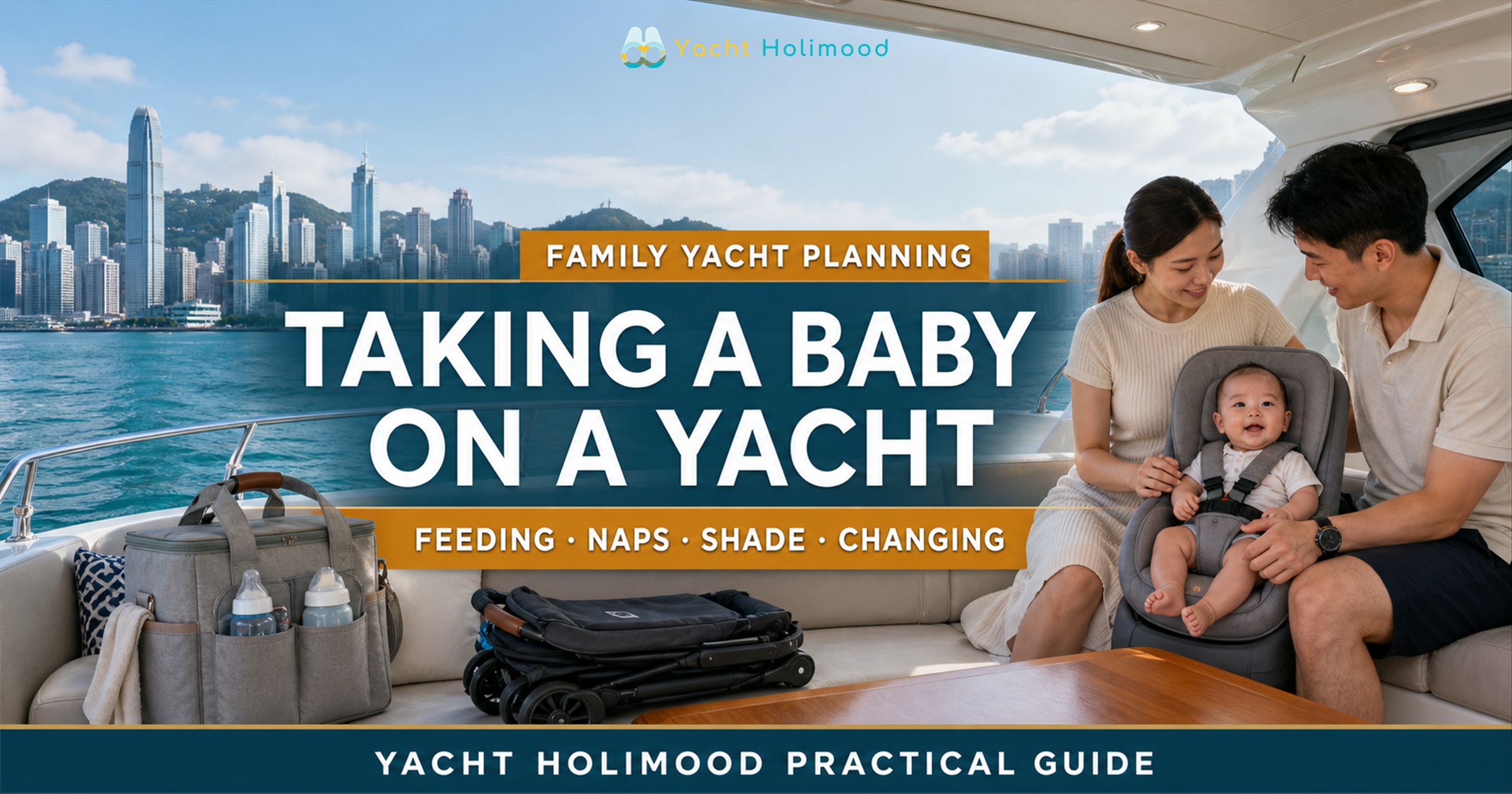
Quick Answer
Taking a baby on a yacht requires a date-, pier-, vessel- and child-specific check. Before booking, confirm the baby’s age and health considerations, a correctly fitting lifejacket, boarding route, shaded and ventilated seating, safe water for formula, cold storage, changing space, nap arrangements, washroom access, early return and bad-weather terms. If any critical condition is unconfirmed, change the vessel or pier, shorten the trip, or postpone it.
A baby experiences heat, noise, motion and disrupted routines differently from an adult. Review the Hong Kong yacht route and water-activity guide, then send the practical brief below to Yacht Holimood. This is planning information, not a substitute for paediatric advice, the skipper’s decision or the operator’s rules.
First decide whether this baby and trip are a sensible match
Do not rely on labels such as “family yacht”. Discuss the baby’s age, prematurity if relevant, recent illness, feeding, naps and motion sensitivity with the family’s healthcare professional. Ask the operator to assess the actual pier, vessel, conditions and lifesaving equipment. If the baby is unwell or feeding unusually on the day, stopping should take priority over deposits or group expectations.
Longer trips and remote anchorages require more feeding, cooling, changing and return planning. For a first outing, consider daylight, shorter duration, fewer boarding steps, a clear indoor seat and an option to return early. Assign adult carers in advance; crew cannot be assumed to feed, hold or supervise a baby.
What should you tell the operator before booking?
Provide the date, duration, area, total guests, baby’s age, folded stroller dimensions, feeding and storage needs, nap time, number of carers, indoor-air-conditioning requirement and manageable boarding steps. Request written details of the exact pier, gangway or steps, handrails, cabin seating, refrigerator or cooler access, safe hot-water method, changing location, waste disposal and emergency return.
Short cruise, half day or full day?
| Factor | Short urban cruise | Half/full day | Confirm before payment |
|---|---|---|---|
| Routine | May fit one feeding and nap cycle | May cross several feeds, naps and changes | Actual departure, anchoring and return times |
| Environment | Closer to shore but piers can be crowded | Longer sun, wind, motion and engine exposure | Indoor seating, shade, ventilation and noise |
| Supplies | Smaller reserve may be workable | More milk, water, nappies and clothing needed | Drinking water, cooling, hot water and waste |
| Early exit | Often easier, but never guaranteed | Returning from offshore takes time | Skipper authority, nearest pier and return terms |
Three common mistakes
“Air conditioning makes it suitable.” It does not solve boarding, lifejacket, wet-surface or evacuation issues. “Holding the baby is always safest.” Adults can lose balance, so use a stable seat and follow crew instructions. “A short trip needs no reserve.” Pier changes, queues or weather can extend the outing.
Formula, expressed milk, food and cleaning
Assign one adult to manage milk and timing. Bring clean, separately packed bottles, measured formula, suitable drinking water, bibs, sealable cleaning bags and a reasonable reserve. Never assume an unverified onboard tap is suitable for infant consumption. If expressed milk, prepared formula or food requires cooling, confirm temperature control, labelling, access and disposal; keep it separate from raw meat, seafood and yacht catering.
Prepare feeds away from edges, hot cooking equipment and busy walkways. The adult should sit securely before handling hot water and must not pour while holding the baby. Pack used bottles and cloths separately for thorough cleaning at home. Clearly disclose special formula, allergy or swallowing needs and keep one named carer responsible.
Plan naps, shade and changing space
A nap location should be away from stairs, open sides, ropes, speakers and heat, with continuous adult supervision. Do not park a stroller on a sloping deck or escape route, and do not attach improvised straps to vessel equipment. Confirm whether a stable cabin area is available, its temperature, lighting and engine noise. If no suitable rest area exists, shorten the trip.
Combine shade, light clothing and avoidance of peak sun; use infant skin products only according to age-appropriate professional guidance. A changing area needs a stable surface, mat, wipes, sealed waste bag and hand-cleaning method, away from food preparation. Prepare everything within reach and keep one hand on the baby.
Boarding, carrying and stroller storage
Assign one adult only to the baby and another to the stroller, bags and documents. Follow crew instructions one person at a time, wear closed non-slip shoes and keep hands free. Measure the folded stroller and confirm its storage so it does not block exits or lifesaving equipment. Tides and wake change the vessel-to-pier gap, so old photos are not a guarantee.
Once aboard, locate the indoor seat, lifesaving equipment, washroom, changing area, milk bag, waste bag and nearest exit before photos or food. The carer should sit securely while underway and stay away from the bow, stairs, wet edges and crowded catering areas.
How to brief Yacht Holimood
Yacht Holimood can help organise options by date, boarding area, headcount, budget and purpose, but the family must still verify each baby-specific condition. Use a current eight-hour daytime option, Victoria Harbour evening option and Sai Kung daytime option only as comparison starting points. Listed amenities are not confirmation for a particular baby.
Send: “Date/time __; adults __; baby’s age __; folded stroller size __; indoor seat/air conditioning __; feed and nap times __; preferred pier __. Please confirm the exact vessel and pier, steps, gangway, shade, correctly fitting lifejacket, drinking water, cooling, changing space, washroom, stroller storage, early return and weather terms in writing.”
Concise CTA
Put the baby’s routine, equipment dimensions and non-negotiable conditions on one page before asking Yacht Holimood to match options. Treat nothing as confirmed until the response identifies the actual vessel and pier.
Day-of checklist
- Reconfirm vessel, pier pin, time, contact and weather decision time.
- Pack sufficient milk, water, nappies, clothing, changing mat and sealed bags.
- Waterproof IDs, medicine, phone and power bank separately.
- Test the appropriate lifejacket and inspect its fastenings.
- Assign primary carer, backup carer and luggage manager.
- On boarding, locate the safe seat, feeding bag, changing area and exit.
- If the baby’s behaviour, feeding, breathing or temperature becomes concerning, notify the group and crew and consider returning.
Frequently Asked Questions
At what age can a baby join a yacht trip?
There is no universal age-only answer. A healthcare professional should consider the baby, while the operator confirms the vessel, pier, conditions and lifesaving equipment.
Can a baby carrier replace a lifejacket?
No. A carrier, inflatable or adult grip is not a substitute for appropriate lifesaving equipment confirmed for the baby’s size and the operator’s rules.
Can formula be prepared onboard?
Only if suitable drinking water, a stable work area and a safe hot-water method are confirmed. Keep supplies separate and never pour hot water while holding the baby.
Can a stroller be wheeled directly aboard?
Not necessarily. Check steps, gangway width, pier gap, folded dimensions and storage, and ensure it cannot block passages or safety equipment.
What if conditions are rough on the day?
Follow the skipper and operator and use the confirmed rescheduling, alternative-pier, shorter-trip or cancellation process. Do not lower the safety threshold because the baby has arrived.
Sources and editorial note
Facilities, piers, routes and safety arrangements can change. This article does not treat listing information as a guarantee for a specific booking.
Holimood Newsletter
Get practical planning checklists for Hong Kong yachts, family activities and outdoor experiences.
This post is also available in:
 繁體中文
繁體中文  简体中文
简体中文

