
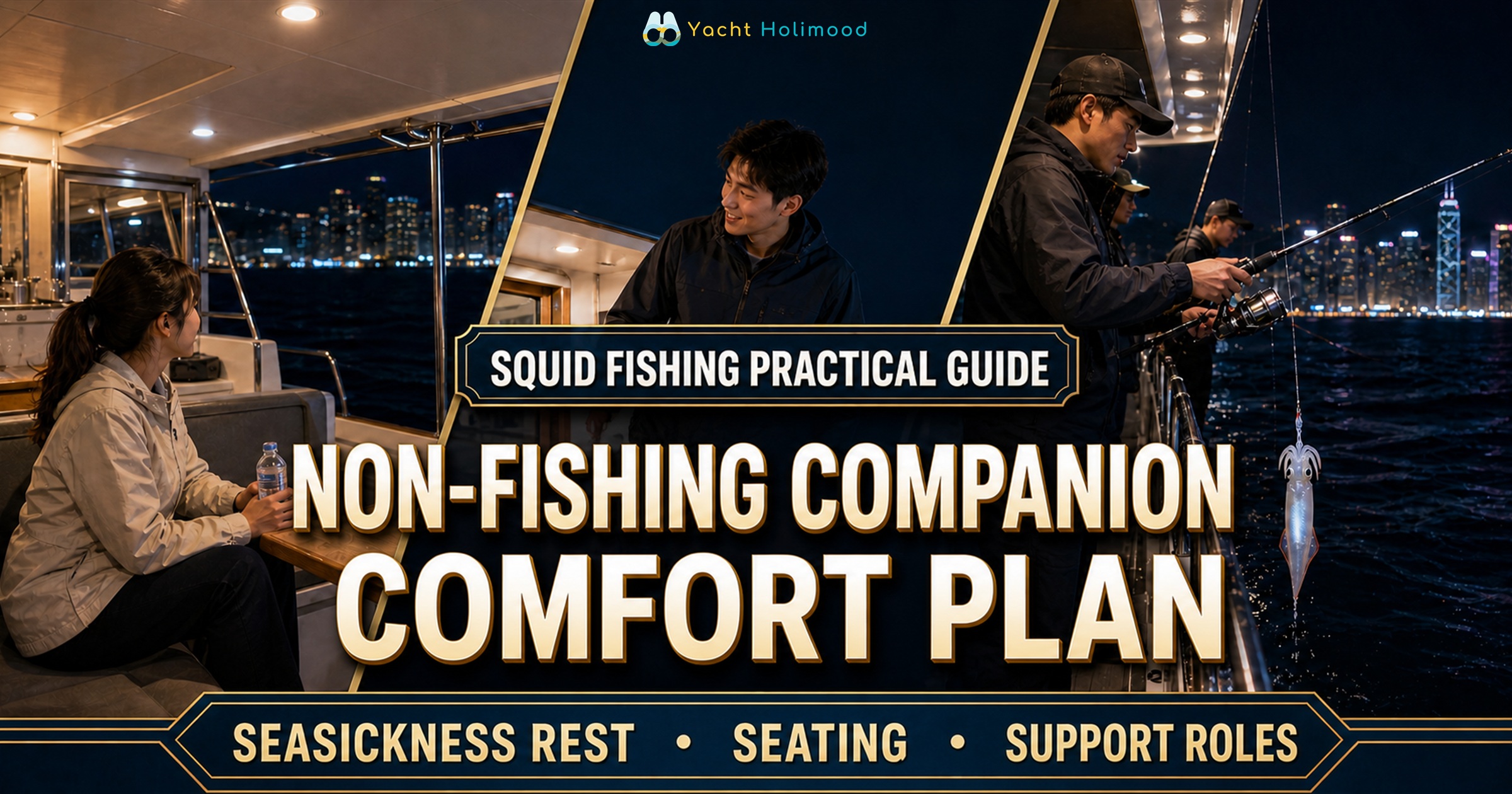
Why plan around a guest who will not fish?
A squid-fishing trip is a sequence of meeting, boarding, cruising, fishing stops, food and the return journey. The practical issue is not whether the guest can be persuaded to hold a rod. It is whether they have a clear, safe place through several hours of vessel movement, deck lighting, noise, smells and changing sea conditions. If they are treated as “just coming along,” tackle may occupy their seat, the quiet area may not be available, or everyone may be at the rail when they need help.
Review the Hong Kong squid-fishing beginner flow and the night squid-fishing gear checklist, then put the companion’s requirements on the same run sheet. Check the Hong Kong Observatory marine forecast before departure. A forecast informs planning; the operator’s safety decision still governs whether and how the trip proceeds.
How specific should seating and rest questions be?
| Item | Confirm before booking | Do not assume |
|---|---|---|
| Secure seat | Whether there is a backrest, handhold or safe fixed seating area, and whether fishing gear occupies it at a stop | A sofa visible in a photo is always available |
| Ventilation and shelter | Open deck, half-covered area or air-conditioned cabin, plus where a guest may rest briefly | A cabin is open throughout every trip |
| Toilet | Whether one is available, any use restrictions and night lighting | Every vessel has the same facilities |
| Boarding | Pier steps, gaps, handrails, meeting time and late-arrival policy | Every pier is level like an indoor walkway |
| Early return | Private versus shared booking, possible changes and applicable terms | One unwell guest automatically triggers a free immediate return |
Seating must follow crew instructions. A guest should never sit in a passageway, at the rail work area, in front of life-saving equipment or within the swing of a rod. GovHK’s boating safety tips and the Marine Department’s pleasure-vessel information provide general context; once aboard, the crew’s directions take priority over a group’s preferred layout.
What should a seasickness rest plan say?
Write it as an action sequence. When the guest first feels uncomfortable, they stop looking at a phone or sorting items, tell the designated contact, and move only as directed by the crew to a ventilated, secure seat that does not block operations. The support companion brings water, tissues and a light jacket while anglers keep tackle inside the work area. If symptoms persist or clearly worsen, notify the crew immediately so they can respond according to route, sea conditions and safety. Medicine suitability, timing and side effects such as drowsiness are medical matters for a doctor or pharmacist, not a promise a travel guide can make.
Divide support roles without emptying the fishing area
A group of four to ten can use three rotating roles: one booking contact, one mobile support companion and one supplies lead. The contact keeps the operator’s number, meeting details and booking record. The support companion stays nearby when the guest rests without obstructing crew. The supplies lead keeps water, dry towels, tissues, a light layer and personal bags together. The point is not rigid job titles; it is making sure someone always knows where the guest is while anglers and crew retain a clear working area.
- Photos: agree who wants to be photographed and do not keep filming someone who is resting.
- Food: separate meals and snacks from the tackle area and confirm onboard catering and waste arrangements.
- Lighting: avoid shining personal lights into another guest’s eyes or the crew’s line of sight.
- Communication: use short phrases in a noisy environment, such as “need a seat” or “please get the crew.”
- Boundaries: a companion may take photos or keep time and does not have to handle catch, bait or wet equipment.
Three common misconceptions
- “If they do not fish, they will not get seasick.” Holding a rod does not determine motion response; a non-fishing guest still needs a rest plan.
- “A cabin is automatically the most comfortable place.” Ventilation, view and smell affect people differently, and the best safe position depends on the vessel, conditions and crew advice.
- “Friends can handle everything without the operator.” Friends provide companionship, but vessel movement, life-saving arrangements, seating limits and emergency decisions remain with qualified crew.
Pre-departure checklist for a non-fishing companion
- Confirm whether the guest will never fish, may try briefly or only wants to take photos.
- Ask the operator about seating, shelter or cabin, toilet and boarding access.
- Review marine weather, thunderstorms and strong-wind information, not a single phone icon.
- Wear closed non-slip shoes and bring water, a light layer, dry towel, tissues and a sealable personal bag.
- Keep the booking, pier location, operator contact, emergency contact and return transport in one group chat.
- Decide who supports a rest break and who remains responsible for tackle.
- Confirm private/shared format, minimum operation, rescheduling, cancellation and early-return terms in writing.
How to match a Yacht Holimood squid-fishing option
Do not compare only the per-person price. For a non-fishing companion, compare vessel type, capacity, sheltered or air-conditioned space, secure seating, toilet, departure point, duration, catering and shared/private format in one table. Yacht Holimood lists options such as SU01 Sai Kung squid fishing with dinner, FJ01 Sai Kung private squid-fishing yacht and BR05 Sai Kung night cruise and squid fishing. Product names indicate the broad format; current availability, price, pier, catering, equipment, rescheduling and companion arrangements must be confirmed on the product page and in writing with the operator.
A single clear enquiry reduces service back-and-forth: “We have eight guests. One will not fish and is prone to seasickness. Which secure, ventilated seating or rest area is available on the scheduled vessel? Please also confirm toilet and boarding access, shared/private format, rescheduling and early-return terms.”
Frequently asked questions
Can someone join a squid-fishing trip without fishing?
Yes, provided the boat has a suitable seat or sheltered rest area and the operator confirms where a non-fishing guest may move safely. Boat layouts vary, so confirm the arrangement before booking.
Where should a seasickness-prone guest sit?
There is no universal position for every boat and sea state. Ask the operator which ventilated, secure seating area is relatively stable on that vessel, and never occupy a passageway or crew work area.
What useful role can a non-fishing companion take?
They can help with water and dry-towel reminders, photos, simple timekeeping and personal belongings, and alert the group leader or crew when someone needs a rest. They should not replace the crew’s safety instructions.
Can the boat return early if a companion feels unwell?
That depends on whether the booking is private or shared, the route, weather and the operator’s terms. Confirm early-return, rescheduling and cancellation arrangements in writing before departure.
Should a companion bring motion-sickness medicine?
Suitability, timing and side effects are personal medical matters. Ask a doctor or pharmacist. This article covers trip planning and does not provide medical advice.
This post is also available in:
 繁體中文
繁體中文  简体中文
简体中文

